
Website Development: A Complete Guide for Businesses to Build a Strong Online Presence
It is not just an online address for a business like it was in the old days anymore, because in today's digital age, a website is much more than that. It assists organizations to deliver information to consumers, highlight their goods or services, develop trust, and create fresh prospects. Whatever
It is not just an online address for a business like it was in the old days anymore, because in today's digital age, a website is much more than that. It assists organizations to deliver information to consumers, highlight their goods or services, develop trust, and create fresh prospects. Whatever their geographic reach, having a properly planned website will help the business to grow in the long run and remain competitive on the internet.
Website Development encompasses the process of designing and keeping a website to business goals, while also delivering a valuable experience to the site visitors. It includes planning, design, coding, functionality, performance optimization, security, and ongoing maintenance. By understanding the following aspects, businesses can make strategic decisions for their new website or current website.
What Is Website Development?
Website development services is a process of creating a website for businesses to share information, offer services and communicate with online users. The type of project may range anywhere from an informational web site to a service based business web site, to an e-commerce web site to a custom web application depending on the project requirements.
Generally, there are two predominant parts to the process: front-end and back-end development.
Front end development aims at areas that visitors can see and interact with like page content, forms, navigation menus, buttons, and layouts. These experiences are typically developed using HTML, CSS, and JavaScript.
Back-end development care of the back end aspects of the application, including data, databases, authentication, server-side logic, and other functions. The technologies chosen are based on the requirements of the website and its complexity.
If these elements are combined, it can offer a uniform experience and meet the needs of the business.
Why Do Businesses Need a Professional Website?
A Website Development can help businesses establish a digital presence and make important information accessible to potential customers. However, its value depends on how well it serves the needs of its audience.
1. Establishes Business Credibility
Potential customers often research a company online before contacting it. A professional website can explain what the business offers, who it serves, and how customers can get in touch.
Clear service descriptions, authentic testimonials, relevant project examples, and accurate contact information can help visitors evaluate the business. Keeping these details updated also makes it easier for customers to understand what to expect.
2. Expands Online Visibility
A website gives businesses a platform to publish useful content and appear in relevant search results. Informational articles, service pages, and location-specific content can help people discover a business when they search for solutions to their problems.
Search visibility is not automatic, though. Businesses need useful content, accessible pages, descriptive page titles, and a technically sound website. Google's SEO Starter Guide explains how website owners can help search engines discover and understand their content.
3. Supports Lead Generation
A business website can turn visitor interest into enquiries through contact forms, consultation requests, quote forms, and clear calls to action.
For example, a service company can explain its process, answer common questions, and provide a straightforward way to request an estimate. Reducing unnecessary form fields and making contact options easy to find can improve the experience for potential customers.
Essential Elements of an Effective Business Website
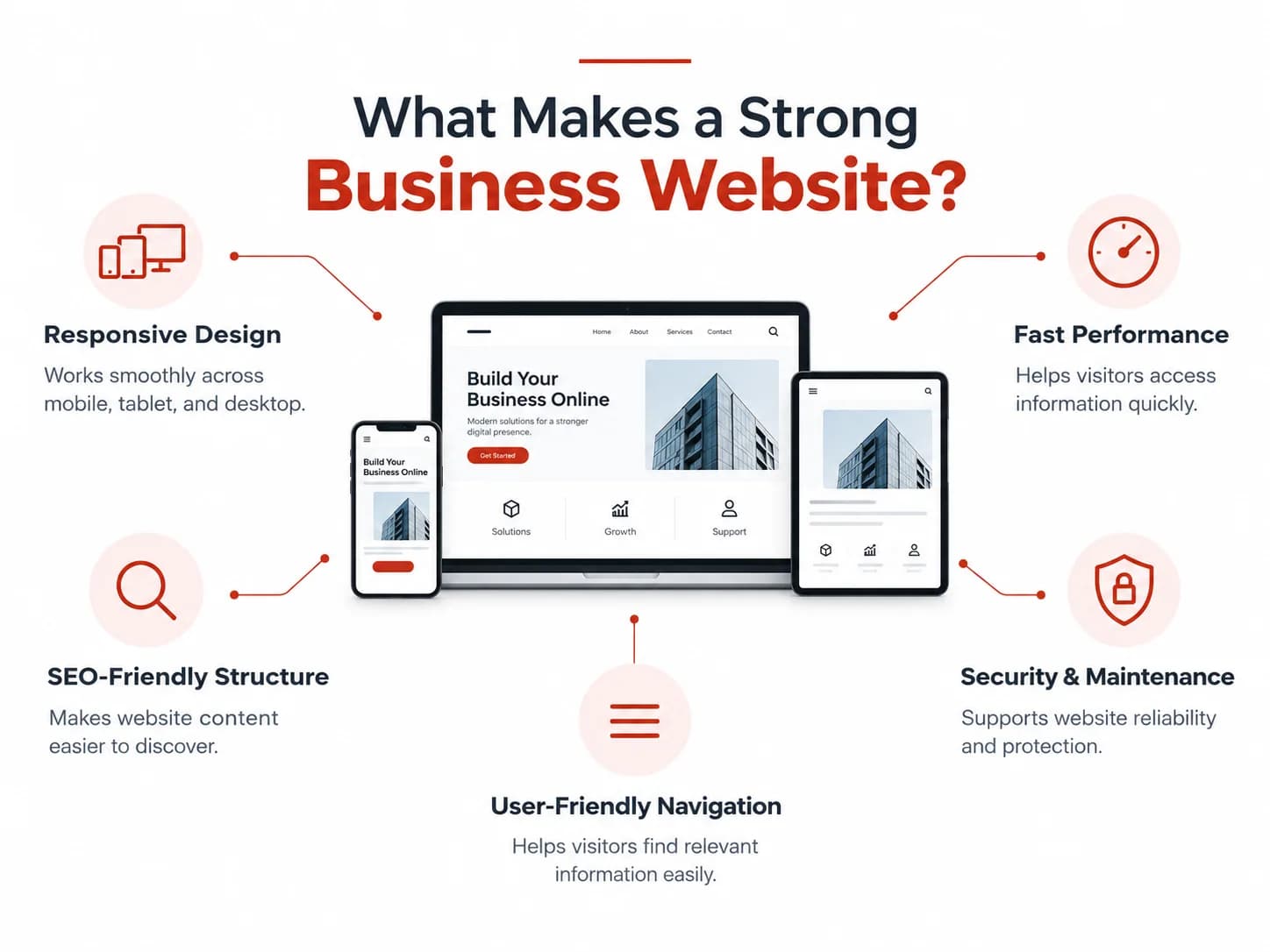
Too good-looking is not enough when it comes to a successful business website development. The website should be usable, accessible, safe and satisfying to its user base.
Responsive Website Design
People can visit a website from their smartphones, tablets, laptop, or desktop computer. Responsive website design makes page layouts responsive to various screen sizes to ensure that text is readable, navigation is functional, and vital buttons are available.
It's important for businesses to conduct device and screen testing on their pages. Mobile users should be able to find out information about the service, fill out forms, and get a hold of the company without having to do a lot of scrolling or frustrating interactions.
Simple Navigation and User Experience
A site's structure should be intuitive and easy to navigate. Menus are easy to read, headings are descriptive, pages have logical categories and consistent navigation.
An online presence for a service business may be arranged around the services offered, company information, examples of projects, blog articles and making contact with details. This enables the website to be more accessible to navigate and allows the user to flow from the information about a service to an inquiry.
Website Speed and Performance
Slow-loading pages can interrupt browsing and make important information harder to access. Performance can be affected by large images, unnecessary scripts, inefficient code, and hosting limitations.
Businesses can improve performance by compressing images, reducing unnecessary resources, enabling appropriate caching, and evaluating their hosting setup. Google's Core Web Vitals documentation explains three important user-experience measurements: loading performance, responsiveness, and visual stability.
Regular performance testing can help identify problems that may not be obvious during everyday browsing.
Security and Data Protection
Websites are a key component in the security of business operations and user information. Useful measures include HTTPS, secure authentication, software updates, reliable backups, access controls and appropriate protections on forms, among others, depending on the website.
Any Web sites that gather personal data should also take into account any privacy requirements that apply, and should make it clear what is done with the information once it has been submitted. Security is a never ending process and development job.
Clear Calls to Action
Calls to action guide visitors toward the next useful step. Examples include “Request a Quote,” “Schedule a Consultation,” and “Contact Our Team.”
The right CTA depends on the business model and visitor intent. A detailed service page may encourage visitors to request a consultation, while an informational blog may direct readers to a related guide or service page.
Understanding the Website Development Process
A structured Website development process helps businesses clarify requirements, manage resources, and reduce avoidable revisions.
Step 1: Define Business Goals
The first step is to determine what needs to be achieved in the website. Objectives could be to generate leads, showcase services, sell products, provide information, or help current customers.
Before development, the target audience, desired actions, required features and available budget should be taken into account.
Step 2: Plan the Website Structure
Make a sitemap that explains the principal pages and the way they’re linked. Create a plan for content to be introduced on each page – purpose, key information, and audience.
This stage is also a chance to find the most suitable search topics and to create internal links between related pages
Step 3: Design and Develop the Website
The design phase sets forth the visual structure, typography, way of navigating and the user interface. Development then takes those designs into reality with the appropriate technologies and content management system or built from scratch.
The technology chosen should be appropriate to the needs of the business and not just fashionable. Consider future updates, integrations, accessibility, scalability, and maintenance needs.
Step 4: Test Before Launch
Test navigation, forms, links, responsive layouts, loading and important user journeys before publishing. Look for page breaks, misspelled words, problems with displays, and security problems.
Additionally, companies should ensure that important analytics and search-engine options are set up properly.
Step 5: Maintain and Improve
Building a website is not the last step. It is updated regularly, backed up, security checked, content updated and performance monitored to ensure over time it remains useful.
The analysis of visitors behaviour and enquiries also can indicate the point where visitors are having problems and which pages could benefit from additional enhancements.
How Website Development Supports SEO
Search engine optimization should be considered during website planning rather than added only after launch.
A logical page structure helps users navigate the website, while descriptive titles and useful content explain what each page offers. Relevant internal links connect related pages and help visitors discover additional information.
For example, a blog discussing website performance could link to a related development service page. An article about online visibility could direct readers to a relevant SEO service page, provided that the destination offers genuinely useful information.
Technical considerations also matter. Search engines need to access important page content, and website owners should check indexability, canonical URLs, XML sitemaps, and mobile usability where applicable.
Businesses can use Google Search Console to monitor search performance, inspect URLs, and identify certain indexing issues.
How to Choose the Right Website Development Approach
The right approach depends on business goals, available resources, technical requirements, and future plans.
A template-based website may suit a business with straightforward requirements and a limited budget. A custom website may be more appropriate when the business needs specialized functionality, unique workflows, or greater control over the user experience.
Before selecting a development partner, review its relevant experience, communication process, project scope, maintenance arrangements, and approach to security and performance. Ask for clear deliverables and confirm who will manage hosting, updates, and future changes.
Businesses should evaluate the overall value of a solution rather than choosing solely on the lowest initial price.
Conclusion
A Website Development that offers valuable content, mindful design, stable performance, security, and continuous improvement is essential for creating a robust online presence. A website, when combined with these elements with clear business goals, can be a valuable tool to draw traffic, solve customer queries, and also generate enquiries.
If you're building a new website, or updating an old one, the first step is to understand your target audience, establish your objectives, and list which website features are important. Learn more about Ignite Web Technologies and the digital services they offer. As businesses evolve, a good website can offer a more sound base for long-term online success.
Put your next idea into action.
Talk to Ignite about your website, application or digital strategy.